St Linus Centenary Photos
|
|
|

1920s land sale advertisement showing the Bain home156 viewsIn 1919 Donald Bain bought the 31 hectares Station Heights Estate, immediately west of the Coburg North railway station. In 1921, He subdivided it into 200 housing blocks and began to sell land and build ‘spec’ houses, firstly from his home in Boundary Road and then from his newly built residence at 21 Orvieto Street. He called the new estate Merlynston, after his daughter Merlyn.
Bain eventually became a local councillor and president of the Merlynston Progress Association which had a hall in Novian Street. The railway station was renamed Merlynston and the street to its immediate east is Bain Avenue.
This land sale advertisement shows Bain's then home on the corner of Merlyn St and Boundary Rd. This house was demolished in 2008.
|
|

1920s Merlynston Estate typical houses149 viewsHouses on the new Merlynston estates were mostly brick, costing more than houses elsewhere in Coburg.
|
|

1920s Original Church Design147 viewsIn 1921 Captain D S Bain subdivided an area of land in North Coburg, calling the estate “Merlynston” after his daughter. The settlement grew as returned soldiers and other young people populated the area, leading to a call to Archbishop Harrington Lees for the provision of a place of worship for Church of England people. The Diocese agreed to purchase the land on which the present church stands together with the two adjoining blocks. In 1925 a church hall was built and was used as the worship centre until the actual church build could commence in 1931.
The architect Charles Heath, who designed the layout of the Fawkner Cemetery, had been chosen to design the St Linus church. He came up with a grand and architecturally impressive building, which, perhaps fortunately, was never completed in its original form.
The nave of St Linus' Church was built in 1932. It was planned as the first section of a most imposing building which, when complete, would have included transepts, a central tower and spire, and a sanctuary. These later sections were never completed.
A temporary wall was erected where the transepts were intended to be placed. It stayed for 46 years until the current east facing large glass window was constructed in 1978.
Charles Heath was also the architect for Coburg Town Hall, the Coburg Holy Trinity Memorial Hall, The Coburg Oval Stand, The Davies St Brunswick Masonic Lodge Hall and many retail buildings around Coburg.
|
|

1921-1923 Merlynston development estates142 viewsThe original 1921 and 1923 development estates are shown in this hand drawn map.
|
|
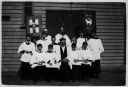
1925 December - Official Opening of the St Linus Hall130 viewsAt a meeting on 1 July 1925, it was resolved that a new hall be built to provide church services for the Anglican people in North Coburg. The hall was built by volunteer labour. The building was begun on 15th August 1925 under Messrs C Ezard, V Black and Henderson, with 30 workmen, and was completed in 14 weekends. Owing to the urgent need for the hall, paid labour was used in the latter stages, and the first service in the hall was conducted by Mr Ball on Sunday, 6 December 1925, with 68 present. Within 7 months of the first Anglican service in Merlynston, the energetic members of this still-rural community were worshipping in a new hall.
|
|
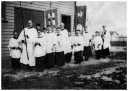
1925 December - Official Opening of the St Linus Hall127 viewsAt a meeting on 1 July 1925, it was resolved that a new hall be built to provide church services for the Anglican people in North Coburg. The hall was built by volunteer labour. The building was begun on 15th August 1925 under Messrs C Ezard, V Black and Henderson, with 30 workmen, and was completed in 14 weekends. Owing to the urgent need for the hall, paid labour was used in the latter stages, and the first service in the hall was conducted by Mr Ball on Sunday, 6 December 1925, with 68 present. Within 7 months of the first Anglican service in Merlynston, the energetic members of this still-rural community were worshipping in a new hall.
|
|

1929 Merlynstnon Public School opening128 viewsMerlynston State School 4328 opened in a new three-storey red-brick building on Bakers Road in 1928, set in grounds that won the A.N.A. garden prize. A large reserve adjoined the school on two sides. The opening was a grand affair, as this newspaper spread attests.
It closed at the end of 1993 and was promptly sold for $1.15m. In 1995 it became the secondary campus of King Khalid Islamic College (now known as Australian International Academy). Fortunately, the Academy retained the imposing red-brick building, which did not have heritage protection at the time.
|
|

1930 Merlynston Junior Football Club129 viewsBy the late 1920s, Merlynston had football and cricket teams. In fact, in 1931 St Linus Church formed its own cricket team which subsequently won the 1933 Coburg Districts Cricket League grand final. Over 300 people attended the club's annual presentation awards in the St Linus Hall to celebrate the win.
|
|

1932 Original St Linus Church Property Plan - architect Charles Heath137 viewsThe architect Charles Heath, who designed the layout of the Fawkner Cemetery, had been chosen to design the St Linus church. His ambitious plan shows the full footprint of a large church, along with hall, vicarage and tennis court. Most of his plan was realised, but the church as envisaged was never fully completed.
|
|

1932-02-20 - Laying of Foundation Stone128 viewsIn January 1932, when the church was under construction, Archbishop Head came for the placing of the memorial stone at the North East corner of the church porch (in Delta Avenue) on Saturday 20 February at 3 PM. The inscription reads:
"To the greater glory of God. This stone was laid on 20th February Anno Domii 1932 by the Most Rev. Frederick Waldergrave Head, D.D.' Archbishop of Melbourne. Rev. W. Clarke Hudson, M.A., Vicar. C.R. Heath A.R.A.I.A., architect".
The mayor (Cr J J Anderson), and other councillors were present, along with a large group of clergy.
|
|

1932-02-20 - Laying of Foundation Stone - the attending clerics129 viewsIn January 1932, when the church was under construction, Archbishop Head came for the placing of the memorial stone at the North East corner of the church porch (in Delta Avenue) on Saturday 20 February at 3 PM. The inscription reads:
"To the greater glory of God. This stone was laid on 20th February Anno Domii 1932 by the Most Rev. Frederick Waldergrave Head, D.D.' Archbishop of Melbourne. Rev. W. Clarke Hudson, M.A., Vicar. C.R. Heath A.R.A.I.A., architect".
The mayor (Cr J J Anderson), and other councillors were present, along with a large group of clergy which included Canon Rowed (who read the lesson), the Rev C H Murray (in 1950, the Bishop of Riverena), who carried the Archbishop's staff,; the Revs H S Hollow, E I Gason, J W Briggs, W A Shaw, A R Sinclair, J A Peck, J J Tempany , L L Nash, A E Sedsman and J V Gason.
|
|

1934 circa - Ken Leslie122 viewsInitially, St Linus Church was part of the parish of Holy Trinity Coburg.
The St Linus vicarage was one of a number of houses built by Captain Bain in the early days of Merlynston as standard residences and was purchased by the Diocese in 1926. A number of curates lived in the house from 1926 to 1946, including Rev. Ken Leslie (later Bishop of Bathurst) who cared for the needs of the St Linus parishioners from January 1934 to May 1937.
|
|

1935 St Linus Choir Easter Times - 1128 viewsA strong musical and ceremonial tradition was evident at St Linus right from the start, with a robed choir gracing the services until 1977.
This holy card shows the Choir times for Easter 1935. It was indeed a full program
Palm Sunday - Matins 9:30AM, Catechism 3PM, Ceremony and Procession 7PM
Wednesday in Holy Week - Eucharist 6:30PM, Evensong 7:30PM
Good Friday - Matins 11AM, Way of the Cross 2:30PM
Holy Saturday - Preparation for HC 7:15PM
Easter Day - Sung Eucharist 9:30AM, Festal Catechism 3PM, Festal Evensong 7PM
|
|

1935 St Linus Choir Easter Times - 2127 viewsA strong musical and ceremonial tradition was evident at St Linus right from the start, with a robed choir gracing the services until 1977.
This holy card shows the Choir times for Easter 1935. It was indeed a full program
Palm Sunday - Matins 9:30AM, Catechism 3PM, Ceremony and Procession 7PM
Wednesday in Holy Week - Eucharist 6:30PM, Evensong 7:30PM
Good Friday - Matins 11AM, Way of the Cross 2:30PM
Holy Saturday - Preparation for HC 7:15PM
Easter Day - Sung Eucharist 9:30AM, Festal Catechism 3PM, Festal Evensong 7PM
|
|

1935 St Linus Church aerial shot125 viewsThis early aerial shot of Merlynston, dated 1935, shows St Linus Church, hall and vicarage on the western side of the photo. The Merlynston Railway station is already in place, as are most of the houses that made up the new 'Merlynston' housing estate.
Passed on by David and Margaret Chambers.
|
|
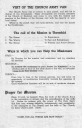
1940s - Army Mission visit to St Linus - back page of flyer116 viewsThis leaflet advertises a Church Army Mission, to be based at St Linus' Church, from June 3rd to 13th, year unknown but almost certainly some time in the 1940s.
Between 1934 and 2010 over 230 men and women were trained and served as Church Army evangelists across Australia. Capt and Mrs Maxwell were amongst those trained missioners.
Sadly, although the Church Army continues to operate in other parts of the world, In 2024, the decision was made to formally wind up the Australian branch of the Church Army, after efforts to revitalise it failed.
|
|
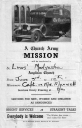
1940s - Army Mission visit to St Linus - front page of flyer122 viewsThis leaflet advertises a Church Army Mission, to be based at St Linus' Church, from June 3rd to 13th, year unknown but almost certainly some time in the 1940s.
Between 1934 and 2010 over 230 men and women were trained and served as Church Army evangelists across Australia. Capt and Mrs Maxwell were amongst those trained missioners.
Sadly, although the Church Army continues to operate in other parts of the world, In 2024, the decision was made to formally wind up the Australian branch of the Church Army, after efforts to revitalise it failed.
|
|
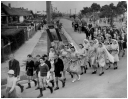
1940s St Linus Procession124 viewsDuring the early years of St Linus, many church groups provided support for generations of parishioners - Sunday School, CEBS (Church of England Boys Society), GFS (Girls Friendly Society), Mothers’ Union and YAF (Young Anglican Fellowship) - as well as contributing vital funds to the ongoing support of the parish.
This photo, from the 1940s, shows the groups processing to the Church as part of some formal occasion. Thoughts anyone?
|
|
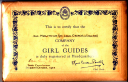
1948 - The 2nd Merlynston Girl Guides (St Linus Church of England)126 viewsThe 2nd Merlynston Girl Guides (St Linus Church of England) was officially launched on Sunday 31st October 1948, under the captaincy of Miss Joyce Lincoln. In a special ceremony, colours were dedicated and presented to the new members. The Church of England Boys Society branch was launched, under Mr E Gibbs, just over a year later, on 6th February 1950. They were amongst a number of groups which used the Church Hall. It was also used for elections, parties, lectures and dances.
Even now, the St Linus Hall plays host to the Fawkner Girl Guides who meet there each Thursday evening.
|
|

1950 Church interior138 viewsThis framed photo, taken in 1950, is a wonderful snapshot of the church interior which enjoyed a local reputation for its beauty. Note the 2 rows of choir stalls are on either side of the worship area. The church had been lovingly cared for by a number of people, particularly Ray Evenden, who had continued the English theme and had put much of his time into maintaining and adding to the decoration of the church. Ray’s embroidery skills were on display in vestments used in worship and frontals and banners that furnished St Linus’.
|
|

1950 Church interior Framed Picture152 viewsThis framed photo, taken in 1950, is a wonderful snapshot of the church interior which enjoyed a local reputation for its beauty. Note the 2 rows of choir stalls are on either side of the worship area. The church had been lovingly cared for by a number of people, particularly Ray Evenden, who had continued the English theme and had put much of his time into maintaining and adding to the decoration of the church. Ray’s embroidery skills were on display in vestments used in worship and frontals and banners that furnished St Linus’.
|
|
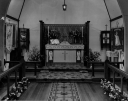
1950 St Linus Altar127 viewsThis photo, produced for the St Linus 25 Year anniversary, showcases the alter which was richly decorated with tapestries and banners.
|
|
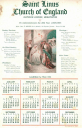
1950 St Linus Church Anniversary Calendar113 viewsThis yearly calendar, produced in 1950 to mark the 25th anniversary of St Linus's founding, shows the vast amount of activity within the fledgling church, with multiple Sunday and weekday services, along with weekly choir practice and meetings of the Girls' Friendly Society, the Mothers' Union, The Guides and the Ladies Guild.
|
|
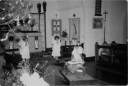
1950s St Linus Nativity Play124 viewsThis 1950s photo shows a Nativity Play taking place in the St Linus Church
|
|

1954 Easter - Rev Oliver Hole132 viewsThe Rev. Oliver Hole was appointed to St Linus’ in 1951. Rev. Hole had previously enjoyed a successful ministry, having been precentor at the Cathedral and Vicar of St Peter’s Box Hill. However, in what was ultimately an unsuccessful arrangement, the Rev’d Hole was sent to St Linus’ with the promise of only a part stipend, but with an additional income stemming from the Chaplaincy to Fawkner Cemetery (which in practice meant taking funerals). This proved unviable and his long tenure in the parish was marked by ongoing financial difficulties and declining income. Fr. Hole eventually retired in 1971, having led the parish for some 20 years.
|
|
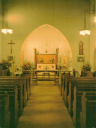
1960s - Old St Linus Altar121 viewsA very nice shot looking towards the old St Linus altar end of the church, before the 1978 renovations were done.
Photo supplied by Ian Pollard.
|
|

1960s St Linus Spring Festival128 viewsDuring the early years of St Linus, many church groups provided support for generations of parishioners - Sunday School, CEBS (Church of England Boys Society), GFS (Girls Friendly Society), Mothers’ Union and YAF (Young Anglican Fellowship) - as well as contributing vital funds to the ongoing support of the parish. Another important contributor to parish finances was the annual parish bazaar. This photo, taken in the 1960s, shows one such bazaar.
|
|

1960s St Linus Spring Festival - Rev. Oliver Hole137 viewsDuring the early years of St Linus, many church groups provided support for generations of parishioners - Sunday School, CEBS (Church of England Boys Society), GFS (Girls Friendly Society), Mothers’ Union and YAF (Young Anglican Fellowship) - as well as contributing vital funds to the ongoing support of the parish. Another important contributor to parish finances was the annual parish bazaar. This photo, taken in the 1960s, shows one such bazaar. Parish priest Rev. Oliver Hole is shown, dressed as usual with biretta and cassock.
"A lasting image is of Oliver Hole riding his bicycle around the streets of Merlynston in the 1950’s, biretta firmly placed on his head, full cassock tucked in around his waist."
|
|
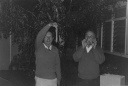
1965 BBQ at Creswell family home in Shorts Road - Charlie Newman and Ray Evenden133 viewsParish stalwarts Charlie Newman and Ray Evenden are shown in this 1965 photo of a parish BBQ at the Creswell family home in Shorts Road.
Photo supplied by Ian Pollard.
|
|
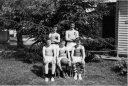
1966 St Linus U16 basketball team 121 views1966 St Linus U16 basketball team
Players: 7 Ian Pollard, 4 Graeme Lukey, 8 Robert King, 14 Alan Trewatha and 5 John Shallard
Photo supplied by Ian Pollard.
|
|
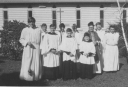
1968 A Festival Day at St Linus132 views1968 A Festival Day at St Linus
Front row:Peter Godden with thurifier, Ron Cruickshank, unknown, Martin Evans with Fr Oliver Hole
Back row: David van Cuylenberg, unknown, Robert King, Ian Pollard and Charlie Newman
Photo supplied by Ian Pollard.
|
|
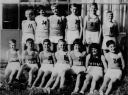
1968 St Linus U14 Basketball team132 viewsAnother photo from Ian Pollard showing the 1968 St Linus U14 Basketball team. Players are
11 Neil Cooper, 34 unknown, 8 Alan Bell, 7 Alan Whiteside, 4 Neil Pollard, 12 Stuart Cooper, 30 John Percival, 9 Geoffrey Maunder, 21 Trevor Sibbald, 6 John Lewis, 20 Michael Crivelli, 33 Greg Lambert, 30 Garry Percival and 24 John Young.
Photo supplied by Ian Pollard.
|
|

1977 Ron Dowling138 viewsIn October, 1975, Bishop Grant (the Regional Bishop) proposed a young priest, the Reverend Ron Dowling who would like to come to St Linus for about 12 months. Ron's appointment as PIC in February 1976 created an air of expectation; the vicarage had been brought up to date and a young priest in his first parish had chosen St Linus’, albeit on a third-time basis. Ron was an ideal choice. He was musical, had a good understanding of Liturgy and was hard working and responsible. After years of relative seclusion the parish was exposed to the wider diocese. Part of Ron's vision was to bring to the parish up to date ideas of worship. He revamped the order of service and worked to create a worship space which suited modern liturgy. In 1978, following the success of a planned giving program, the church building was finally completed. When Ron Dowling left the parish (now 1/2 time) on Christmas Day, 1978 to pursue his MA overseas, he left a parish that was markedly different to the one he joined in 1975.
This photo, taken in 1977, predates the church building completion and shows Ron leading the service at the old altar at the eastern end of the church.
|
|

1978 Church Renovations 1131 viewsFor years the unfinished wall of the church had been a source of embarrassment and was a physical reminder of the neglect of the parish over the years. It also worked against the establishment of a solid foundation for ministry. In 1977, following the success of the planned giving programme, the Vestry decided, with the support of Bishop James Grant, that the building should be completed. Mr Vanne Trompf, a creative architect who had successfully carried out some work to Anglican churches, came up with a wonderful solution to replace the temporary wooden eastern wall with a new glass window. The renovation also included a new vestry and church entrance and required the altar to be moved from the eastern end to the western end of the church. The building work was completed and was blessed by Archbishop Robert Dann in a Re-dedication Ceremony on 5th November 1978. A morning prayer service was held at 8:00 AM, followed by a prayer vigil which lasted until the re-dedication ceremony commenced at 4:00 PM.
|
|

1978 Church Renovations 2133 viewsFor years the unfinished wall of the church had been a source of embarrassment and was a physical reminder of the neglect of the parish over the years. It also worked against the establishment of a solid foundation for ministry. In 1977, following the success of the planned giving programme, the Vestry decided, with the support of Bishop James Grant, that the building should be completed. Mr Vanne Trompf, a creative architect who had successfully carried out some work to Anglican churches, came up with a wonderful solution to replace the temporary wooden eastern wall with a new glass window. The renovation also included a new vestry and church entrance and required the altar to be moved from the eastern end to the western end of the church. The building work was completed and was blessed by Archbishop Robert Dann in a Re-dedication Ceremony on 5th November 1978. A morning prayer service was held at 8:00 AM, followed by a prayer vigil which lasted until the re-dedication ceremony commenced at 4:00 PM.
|
|

1978-11-5 Re-dedication136 viewsFor years the unfinished wall of the church had been a source of embarrassment and was a physical reminder of the neglect of the parish over the years. It also worked against the establishment of a solid foundation for ministry. In 1977, following the success of the planned giving programme, the Vestry decided, with the support of Bishop James Grant, that the building should be completed. Mr Vanne Trompf, a creative architect who had successfully carried out some work to Anglican churches, came up with a wonderful solution to replace the temporary wooden eastern wall with a new glass window. The renovation also included a new vestry and church entrance and required the altar to be moved from the eastern end to the western end of the church. The building work was completed and was blessed by Archbishop Robert Dann in a Re-dedication Ceremony on 5th November 1978. A morning prayer service was held at 8:00 AM, followed by a prayer vigil which lasted until the re-dedication ceremony commenced at 4:00 PM.
|
|
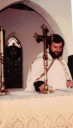
1979 Rev. Peter Whyte126 viewsRev. Peter White was the vicar of St Linus Merlynston from 1979 to 1983.
|
|
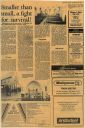
1979-09-20 St Linus Church Refurbishment article136 viewsSt Linus featured in 'Church Scene' in 1979, the article written by new Priest in Charge Rev.Peter White.
|
|
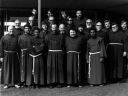
1980s Brother Rodney Godden Anglican Franciscans121 viewsA event of note occurred in July, 1966, when a long-standing parishioner, Rodney Godden was congratulated by the Vestry on the occasion of his profession to the Society of St Francis, thus following in the steps of parishioner Sr Phillipa who had joined the Community of the Holy Name at Cheltenham. In time, Brother Rodney became the Provincial of the world-wide Anglican Franciscan order in New York. Rodney is far right in the back row.
This photo was probably taken in the 1980s and was given to us by Ian Pollard.
|
|

1980s mid - Alan Cadwallader a haircut for a good cause142 viewsRev Alan Cadwallader who had been at Holy Trinity Kensington, took over the Parish in late 1982. Fr Alan was married and the parish, after some time, once again had a family at St Linus’ House. Alan and Robin’s family of two children increased to four during their five years at St Linus’. This was a time of much creativity and spiritual growth. Outreach to the community increased as Alan’s spirit of inclusiveness found an expression in events such as the annual parish camp, attended by parishioners of all age groups and others, including the from kindergarten. The annual Spring Festival, Easter and St Linus Day celebrations of Eucharist and feasting were very popular and the introduction of a Sunday night Taize service flowed from the raised interest in liturgical issues and attracted numbers of people from outside the parish. When Fr Alan left the parish in 1988, he left a legacy seen not only in the physical fabric of the church plant, but also in the deep spiritual growth of many parishioners.
|
|

1980s mid - Spring Festival136 viewsRev Alan Cadwallader who had been at Holy Trinity Kensington, took over the Parish in late 1982. Fr Alan was married and the parish, after some time, once again had a family at St Linus’ House. Alan and Robin’s family of two children increased to four during their five years at St Linus’. This was a time of much creativity and spiritual growth. Outreach to the community increased as Alan’s spirit of inclusiveness found an expression in events such as the annual parish camp, attended by parishioners of all age groups and others, including the from kindergarten. The annual Spring Festival, Easter and St Linus Day celebrations of Eucharist and feasting were very popular and the introduction of a Sunday night Taize service flowed from the raised interest in liturgical issues and attracted numbers of people from outside the parish. When Fr Alan left the parish in 1988, he left a legacy seen not only in the physical fabric of the church plant, but also in the deep spiritual growth of many parishioners.
|
|
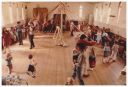
1980s mid - Spring Festival Colour126 viewsRev Alan Cadwallader who had been at Holy Trinity Kensington, took over the Parish in late 1982. Fr Alan was married and the parish, after some time, once again had a family at St Linus’ House. Alan and Robin’s family of two children increased to four during their five years at St Linus’. This was a time of much creativity and spiritual growth. Outreach to the community increased as Alan’s spirit of inclusiveness found an expression in events such as the annual parish camp, attended by parishioners of all age groups and others, including the from kindergarten. The annual Spring Festival, Easter and St Linus Day celebrations of Eucharist and feasting were very popular and the introduction of a Sunday night Taize service flowed from the raised interest in liturgical issues and attracted numbers of people from outside the parish. When Fr Alan left the parish in 1988, he left a legacy seen not only in the physical fabric of the church plant, but also in the deep spiritual growth of many parishioners.
|
|
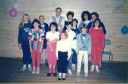
1980s Rev. John Simpson with the St Linus Girls Friendly Society129 viewsRev. John Simpson was the vicar of St Linus Merlynston from 1988 to 1990. This photo shows him with Elizabethy Berridge and the girls from the St Linus Girls Friendly Society.
|
|
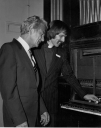
1983 - Moyle Organ Appeal Launch - Prime Minister Bob Hawker with vicar Alan Cadwallader.142 viewsIn 1982, a project commenced to restore the Moyle Organ, a small chamber organ built for a residence, previously used in St Cuthbert’s Brunswick. The organ had been stored by Christ Church Brunswick for some time. St Linus’ expressed a degree of interest in the instrument in 1978. Matters slowly progressed and eventually an appeal was launched under the auspices of the Organ Historical Trust of Australia, with the then local member for Wills, Mr Bob Hawke, and the Archbishop joint patrons of the appeal. The organ was stored in pieces in the hall, the vicarage kitchen cupboards and in local garages until restoration commenced.
The organ appeal was officially launched in November 1993 by the then Prime Minister Hawke, in the company of parishioners, invited guests and journalists, a large number of police and security people and a group of uranium protesters who had followed him from a meeting at the Coburg Town Hall. The afternoon was a great occasion for the parish and the ensuing publicity was of benefit to the appeal.
|
|
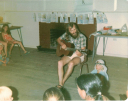
1984 Rev. Allan Cadwallader on the guitar122 viewsRev. Allan Cadwallader was the vicar of St Linus Merlynston from 1983 to 1988. Here Allan provides the music at St Linus Kindergarten Christmas Carols in 1984.
|
|

1987 St Linus Op Shop Opening133 viewsRev. Alan Cadwallader's time as Parish Priest saw many initiatives in the parish. The hall was renovated and finally re-blocked, an Op Shop was opened, the Moyle Organ was installed, parish camps were commenced and the fete became a highly organised affair. The Parish Op Shop was opened in 1987 and ran for many years as a valuable resource for the local community.
|
|

1987 St Linus Op Shop Workers137 viewsRev. Alan Cadwallader's time as Parish Priest saw many initiatives in the parish. The hall was renovated and finally re-blocked, an Op Shop was opened, the Moyle Organ was installed, parish camps were commenced and the fete became a highly organised affair. The Parish Op Shop was opened in 1987 and ran for many years as a valuable resource for the local community.
|
|

1988 Good Friday 1124 viewsThe church, as it now stands, is a wonderful example of church architecture.
The building is notable for its absence of ornamentation and for its lofty, well-proportioned interior. It is the only known example of Heath's church architecture, although he carried out considerable work at Fawkner Crematorium nearby.
This photo shows the sanctuary, at the western end of the church.
|
|
|
|


 Home
Home Login
Login Album list
 Last uploads
 Last comments
 Most viewed
 Top rated
 My Favorites
 Search