St Linus Centenary Photos
|
|
|
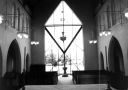
1988 Good Friday 2128 viewsThe church, as it now stands, is a wonderful example of church architecture.
The building is notable for its absence of ornamentation and for its lofty, well-proportioned interior. It is the only known example of Heath's church architecture, although he carried out considerable work at Fawkner Crematorium nearby.
This photo looks towards the eastern end of the church and shows the crossing arch which is filled with a striking steel and glass structure which houses the baptistry,
|
|
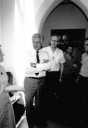
1990 March - Local member Bob Hawke with vicar John Simpson134 viewsThe 1990 Federal Election was held in March of that year and St Linus was one of the Wills Electorate polling booth. Prime Minister Bob Hawke was our local member and dropped in and is pictured here in the church with vicar John Simpson.
|
|
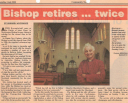
2000 Bishop Jeremy Ashton retires at the age of 70 years125 viewsIn November, 1995 Bishop Jeremy Ashton was placed in charge of the parish. Bringing a strong personal spirituality and a commitment to the local community, a driving interest in a number of ethical issues, including aboriginal welfare and an involvement in inter-church activities, Jeremy offered care and stability to the congregation during the 5 years of his ministry at St Linus.
|
|
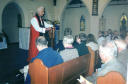
2000 July - Final Service at St Linus for our vicar Bhp Jeremy Ashton127 viewsBhp. Jeremy Ashton came out of retirement to take on the role of vicar at St Linus in November 1995. He spent 5 years as our vicar before retiring once again in July 2000. This photo shows him delivering his final sermon in his final service in July 2000.
|
|
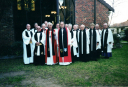
2000 July - Final Service at St Linus for our vicar Bhp Jeremy Ashton116 viewsBhp. Jeremy Ashton came out of retirement to take on the role of vicar at St Linus in November 1995. He spent 5 years as our vicar before retiring once again in July 2000. His final service saw many clergy in attendance, a measure of the esteem in which he was held by his fellows in the Diocese of Melbourne.
|
|
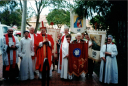
2001 Amalgamation Service - Locum Noel Delbridge, Bhp Andrew Kernow, Jeanette Keeble123 viewsThis 2001 Service at St Linus marked the formal amalgamation of the Parishes of St Linus Merlynston with St Matthew's Glenroy. The photo shows, amongst others, Rev Noel Delbridge, Bhp Andrew Kernow and Rev Willy Maddocks.
|
|
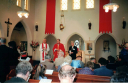
2001 Amalgamation Service - Locum Noel Delbridge, Bhp Andrew Kernow, Jeanette Keeble129 viewsThis 2001 Service at St Linus marked the formal amalgamation of the Parishes of St Linus Merlynston with St Matthew's Glenroy. This photo shows Rev. Noel Delbridge, Bhp Andrew Kernow and Jeanette Keeble
|
|
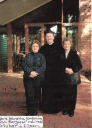
2002 Margaret Johanesen, Rev Tim Fox, Eileen De Moore127 viewsThis photo, taken on the St Linus Church front porch, shows curate Rev Tim Fox with St Linus parishioners Margaret Johanesen and Eileen de Moore.
Photo supplied by Ian Pollard.
|
|
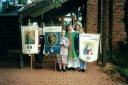
2002 Norma Lion Margaret Johanesen Rev Tim Fox Alex Koenders Coleen Wetzel129 viewsThis 2002 photo, taken on the front porch of the St Linuc Church, shows Norma Lion, Margaret Johanesen, Rev Tim Fox, Alex Koenders and Coleen Wetzel.
Photo supplied by Ian Pollard.
|
|
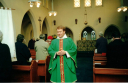
2002 Rev. Timothy Fox leads a St Linus Church Sunday service119 viewsRev. Timothy Fox became the curate of our parish, under vicar Rev. Willi Maddocks, after the amalgamation in 2001. This photo shows him leading a Sunday church service at St Linus.
|
|
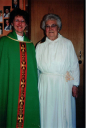
2004 Rev. Sophie Watkins with Norma Lyon129 viewsRev. Sophie Watkins acted as Locum Priest for the period between Rev. Wili Maddocks finished in 2004 and Rev. Stuart Gardiner took over the reins in 2005. This photo, taken in 2004, shows her with Norma Lyon, one of our oldest and most committed St Linus parishioners.
|
|
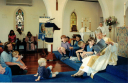
2004 Rev. Willy Maddocks reads a story to the children133 viewsRev. Willy Maddocks was the vicar of St Matthew's Glenroy from 1995 to 2001 and then became the vicar of the newly combined parish of St Matthew's Glenroy with St Linus' Merlynston. Willy had a very active vision of extending the service to include the younger members of the parish. Here she reads a story to the younger congregation members at St Linus during one of her Sunday services.
|
|

2006 - Moyle Organ, built by James Moyle of Prahran circa 1855 and restored by George Fincham & Sons, Melbourne, in 1985138 viewsThis organ was built, probably in the 1850s, by James Moyle, of Prahran. It is thought to be the earliest surviving example of organbuilding in Victoria. The original location of the instrument is unknown and its history is vague until its arrival at St Cuthbert's Anglican Church, Brunswick, about 1930. At some stage the pedal pulldowns were added and the hand-blowing arrangements modified. About 1975, the organ was removed from St Cuthbert's Church and stored at Christ Church, Brunswick. The organ was subsequently given to the National Trust of Australia (Victoria) by the Christ Church parish and it was decided to place the instrument, following restoration, at St Linus' Church on permanent loan.
The restoration of the instrument began in early 1984 following the launching of a restoration appeal by the Prime Minister of Australia, Bob Hawke. The work was carried out by George Fincham & Sons, of Richmond.
This small instrument, of chamber organ dimensions, has a distinctive Gothic case. There are three flats of gilt wooden dummy pipes placed within three cusped arches. The cornice of-the case is boldly crenellated and the music desk, carved in oak, incorporates a lyre motif. The casework is of pine which has been stained and finished to resemble cedar, although the latter material has been used for the keyboard assembly. The hood moulds above the three cusped arches were at some stage removed and have been replaced. The original builder's nameplate survives.
|
|

2006 - Moyle Organ, built by James Moyle of Prahran circa 1855 and restored by George Fincham & Sons, Melbourne, in 1985130 viewsThis organ was built, probably in the 1850s, by James Moyle, of Prahran. It is thought to be the earliest surviving example of organbuilding in Victoria. The original location of the instrument is unknown and its history is vague until its arrival at St Cuthbert's Anglican Church, Brunswick, about 1930. At some stage the pedal pulldowns were added and the hand-blowing arrangements modified. About 1975, the organ was removed from St Cuthbert's Church and stored at Christ Church, Brunswick. The organ was subsequently given to the National Trust of Australia (Victoria) by the Christ Church parish and it was decided to place the instrument, following restoration, at St Linus' Church on permanent loan.
The restoration of the instrument began in early 1984 following the launching of a restoration appeal by the Prime Minister of Australia, Bob Hawke. The work was carried out by George Fincham & Sons, of Richmond.
This small instrument, of chamber organ dimensions, has a distinctive Gothic case. There are three flats of gilt wooden dummy pipes placed within three cusped arches. The cornice of-the case is boldly crenellated and the music desk, carved in oak, incorporates a lyre motif. The casework is of pine which has been stained and finished to resemble cedar, although the latter material has been used for the keyboard assembly. The hood moulds above the three cusped arches were at some stage removed and have been replaced. The original builder's nameplate survives.
|
|

2006 - Moyle Organ, built by James Moyle of Prahran circa 1855 and restored by George Fincham & Sons, Melbourne, in 1985135 viewsThis organ was built, probably in the 1850s, by James Moyle, of Prahran. It is thought to be the earliest surviving example of organbuilding in Victoria. The original location of the instrument is unknown and its history is vague until its arrival at St Cuthbert's Anglican Church, Brunswick, about 1930. At some stage the pedal pulldowns were added and the hand-blowing arrangements modified. About 1975, the organ was removed from St Cuthbert's Church and stored at Christ Church, Brunswick. The organ was subsequently given to the National Trust of Australia (Victoria) by the Christ Church parish and it was decided to place the instrument, following restoration, at St Linus' Church on permanent loan.
The restoration of the instrument began in early 1984 following the launching of a restoration appeal by the Prime Minister of Australia, Bob Hawke. The work was carried out by George Fincham & Sons, of Richmond.
This small instrument, of chamber organ dimensions, has a distinctive Gothic case. There are three flats of gilt wooden dummy pipes placed within three cusped arches. The cornice of-the case is boldly crenellated and the music desk, carved in oak, incorporates a lyre motif. The casework is of pine which has been stained and finished to resemble cedar, although the latter material has been used for the keyboard assembly. The hood moulds above the three cusped arches were at some stage removed and have been replaced. The original builder's nameplate survives.
|
|
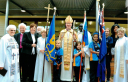
2016 Blessing of new St Linus Hall126 viewsThe old St Linus Hall had been built in the late 1920s and had well and truly reached it use-by-date by the early 2000s. Under the guidance of then vicar Rev. Jo-Anne Wells, funds were sourced and a new hall was built. The photo shows the official opening on Sunday 25th September 2016.
|
|
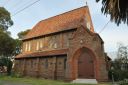
2016 Church Delta Avenue view136 viewsThis 2016 photo of St Linus shows the northern side, from Delta Avenue. This was originally the front entrance to the church, and the memorial stone (laid in 1932) is just to the left of the front porch.
|
|

2016 Church Front View124 viewsThis 2016 photo shows the front window, as viewed from Glyndon Avenue. This window was erected as part of the 1978 refurbishment and replaced what was a temporary wooden wall, erected in 1932 when the church building had to be stopped as available funds were exhausted. It was a temporary wall that lasted 46 years!
|
|

2016 Church Front View126 viewsThis 2016 photo shows the front window, as viewed from Glyndon Avenue. This window was erected as part of the 1978 refurbishment and replaced what was a temporary wooden wall, erected in 1932 when the church building had to be stopped as available funds were exhausted. It was a temporary wall that lasted 46 years!
|
|

2016 Church Window133 viewsThis 2016 photo shows the front window, in side profile. This window was erected as part of the 1978 refurbishment and replaced what was a temporary wooden wall, erected in 1932 when the church building had to be stopped as available funds were exhausted. It was a temporary wall that lasted 46 years!
|
|

A St Linus Gathering of Parishioners133 viewsDate and occasion unknown.
|
|
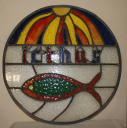
ICHTHUS Stained Glass Panel123 viewsThis stained glass panel was designed and created by Christian Johanesen, using glass recycled from the old windows in the Church Hall. Unfortunately, it has not found a permanent display area in the church but sits against one of the church's stained glass windows.
It is based on the fish symbol used by early Christians to identify themselves and as a profession of faith. The church remains very thankful to Chris for this lovely gift of his skill.
|
|
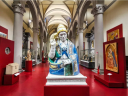
St Linus - Museo Diocesano de Arte Sacra in Volterra122 viewsThe Diocesan Museum of Sacred Art is located inside the Church of Sant’Agostino in Volterra, Italy, and conserves works of art coming from the Cathedral Basilica, churches in the city and other religious institutions in the diocese. Amongst the most important works on display is a glazed terracotta bust of St. Linus, the second pope and patron saint of Volterra, made by Giovanni della Robbia in 1521.
|
|
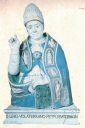
St Linus - Museo Diocesano de Arte Sacra in Volterra121 viewsThe Diocesan Museum of Sacred Art is located inside the Church of Sant’Agostino in Volterra, Italy, and conserves works of art coming from the Cathedral Basilica, churches in the city and other religious institutions in the diocese. Amongst the most important works on display is a glazed terracotta bust of St. Linus, the second pope and patron saint of Volterra, made by Giovanni della Robbia in 1521.
|
|
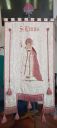
St Linus Banner133 viewsThe Rev’d W Clarke Hudson left a memorandum concerning his choice of Saint Linus as patron saint, in which he wrote:
“St Linus was chosen as the patron saint of this church because he was a Briton, almost the first Briton mentioned in history, and certainly the first British saint. He was the son of King Caradoc, who, tradition relates, was converted to Christianity by the mission to Glastonbury about the middle of the first century. King Caradoc was conquered and carried captive with his family to Rome by the Emperor Claudius, but his noble demeanour so affected Claudius that the latter gave Caradoc his liberty, and that of his whole family, who thus became Roman citizens. Linus was the first Bishop of Rome, sometime between 56 and 80 AD. St Paul, in his second Epistle to Timothy , Chapter 4, verse 21, numbers Linus, Claudia and Pudens (her husband) among the early Christians. The Apostolical Constitutions tell us that Linus and Claudius were brother and sister. We learn from tradition that Linus was beheaded by order of Saturninus for refusing to give up the faith”
|
|
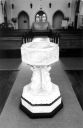
The Baptismal Font132 viewsIn November 1932, the church was the recipient of a magnificent gift of the marble font, made secretly by Mr H J Thornton during 2 years' work. It was dedicated on Wed 23 November at 8 PM by the Rural Dean, Canon Rowed. The first baptism in the new font followed immediately, that of Mr Thornton's granddaughter, Patricia Joan Murray. The font has been much praised over the years and has pride of place in the large window of the completed church building, inviting passers-by to enter God’s kingdom through baptism.
|
|
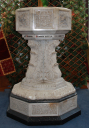
The St Linus Baptismal Font - Plaque123 viewsIn November 1932, the church was the recipient of the magnificent gift of a marble font made secretly by Mr Hubert J Thornton over 2 years. It was dedicated on Wednesday 23rd November at 8 PM by the Rural Dean, Canon Rowed. The first baptism in the new font followed immediately, that of Mr Thornton's granddaughter, Patricia Joan Murray. The font has been much praised over the years and has pride of place in the large window of the completed church building, inviting passers-by to enter God’s kingdom through baptism.
|
|
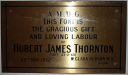
The St Linus Baptismal Font - Plaque118 viewsIn November 1932, the church was the recipient of the magnificent gift of a marble font made secretly by Mr Hubert J Thornton over 2 years. It was dedicated on Wednesday 23rd November at 8 PM by the Rural Dean, Canon Rowed. The first baptism in the new font followed immediately, that of Mr Thornton's granddaughter, Patricia Joan Murray. The font has been much praised over the years and has pride of place in the large window of the completed church building, inviting passers-by to enter God’s kingdom through baptism.
|
|

Window - 1927 Peter Lorensen127 viewsOn Christmas Eve, 1927, Mr Peter Lorensen died. A native of Denmark who resided in Australia for over 60 years, Peter attended St Paul’s Cathedral until services started in the St Linus hall. He became a regular attendant and “the quiet influence of his genial Christian character won a wide circle of friends". Lorensen Avenue in Merlynston is named after him; however, he left a greater legacy – he left £1,000 for the building of a brick church, which made the consideration of that project possible. The legacy was to be paid over 1932, provided that by that time sufficient funds has been raised to make up the amount needed to build a brick church.
|
|

Window - 1935 Rev William Clarke Hudson127 viewsThe Rev William Clarke Hudson was the vicar of Coburg from 1920 to 1935 and was one of the driving forces behind the creation of St Linus. In his younger days he had served in country parishes in NSW and Queensland. When rector of Croydon and Normanton on the Gulf of Carpentaria he was in charge of a parish well over 100 miles long but his only means of travel was a push-bike. In Coburg he still pushed his bicycle all over the parish.
He spearheaded the push to raise funds, build first a church hall and then build the brick St Linus Church. The memorial stone on the SE Corner of St Linus Church reads
"To the greater glory of God. This stone was laid on 20th February Anno Domii 1932 by the Most Rev. Frederick Waldergrave Head, D.D.' Archbishop of Melbourne. Rev. W. Clarke Hudson, M.A., Vicar. C.R. Heath A.R.A.I.A., architect".
The Rev William Clarke Hudson concluded his ministry at St Linus' in February 1935, his last service being Evensong on Friday the 28th.
|
|

Window - 1946 Elizabeth Nora Badger Baptism127 viewsWhen peace came at the end of WWII, the church felt strong enough to contemplate emerging as a separate parish. Archbishop Booth was able to meet this wish when the Rev Edwin Badger became available upon his discharge from the army. He was accordingly instituted as the first Vicar of the Parochial District of Merlynston, on Monday 29th July, 1946 at 8PM by Archdeacon J A Schofield, with the double task of building up Merlynston and Fawkner into a self-supporting parish, while making the project financially possible by discharging the duties of chaplain to the Fawkner Cemetry. Fr Badger remained as Parish Vicar until 1951.
|
|

Window - 1947 George and Elsie Evenden130 viewsThe Evenden family stained glass window,dedicated on 8th May 1949, depicting the Lamb of God, was unveiled by Mrs L Thomas, the daughter of Mr and Mrs Evenden. The Evenden family had been St Linus stalwarts since the church's inception in 1925. Their son Ray Evenden was a mainstay of the parish for many years, organising the choir, running the practice, played the organ and running the CEBS. He also took it on himself to recruit people to the parish. Of boundless energy and having a deep faith, he served the parish well. Many St Linus’ people over the years could trace their introduction to Anglicanism to Ray.
|
|

Window - 1949 Amelia Stubbings134 viewsAmelia Stubbings, of O'Hea St in Coburg, was Ray Evenden's aunt and, although a longstanding and faithful member of Holy Trinity Coburg, was a loyal supporter of the newly established St Linus' Church. After her death, the Evenden family had this window installed at St Linus. It reads:
In loving memory of Amelia Stubbings
Obiit 15th July 1949, aged 81 years.
A faithful member of the parish of Holy Trinity Coburg
and a friend of this church.
|
|

Window - 1952 Errol Robert Warnock129 viewsErrol Robert Warnock died 21 March 1952, aged 13 years, as the result of an accident. The dearly loved son of Robert and Linda Warnock of 87 Queens Pde Fawkner, and loved brother of Ron, aged 14 years.
|
|

Window - 1952 Errol Robert Warnock133 viewsErrol Robert Warnock died 21 March 1952, aged 13 years, as the result of an accident. The dearly loved son of Robert and Linda Warnock of 87 Queens Pde Fawkner, and loved brother of Ron, aged 14 years.
|
|

Window - 1958 Go Forth128 viewsA number of gifts were received in Fr Hole’s time. A glass window – “Administering of Holy Communion to a Papuan Boy” given anonymously, was blessed 14 Dec, 1958.
|
|

Window - 1996 Frederick Maurice Van Cuylenburg125 viewsThe van Cuylenburg and de Moore families were steadfast supporters of St Linus Parish from the 1950s onwards. Eileen de Moore was the church organist for many years, while her brother Maurice van Cuylenburg lent his legal expertise to the parish on many occasions.
|
|

Window - 2022 Jo-Anne Wells and Lois Erickson137 views2020 saw the passing of two very significant people in the St Linus story. First, in August of that year, long serving parishioner Lois Erickson died after a long battle with cancer. Lois's association with St Linus started in the early 1950s as a small child and she spent nearly 70 years as a dedicated member of the church community, taking on roles as Vestry member, Church Council member, Church Warden, Parish Treasurer and Kindergarten President and Treasurer. The Rev. Jo-Anne Wells took on the role of vicar of the Parish of St Matthew's Glenroy with St Linus' Merlynston in November 2011 and served in that capacity until her untimely passing in October 2020. She brought much love, empathy, tolerance and compassion to her role, along with a passion for helping refugees. The members of the parish raised the necessary finances to erect this window, in memory of these two lovingly remembered people.
The window features Jesus with children, to honour Jo-Anne’s work with Playgroup and St. Linus’ kindergarten, and Lois’ tireless work with the Kindergarten, over many, many years.
|
|

Window behind organ122 viewsYou can easily miss this final stained glass window, given that it is hidden behind the Moyle organ, on the northern side of the church. It has no additional writing to indicate that it has been created in memorial of some significant person. It is simply a stained glass window, if there is such a thing! All stained glass windows tell their own story.
|
|
|
|
|


 Home
Home Login
Login Album list
 Last uploads
 Last comments
 Most viewed
 Top rated
 My Favorites
 Search