 Most viewed - St Linus Centenary Photos
|

1920s land sale advertisement showing the Bain home165 viewsIn 1919 Donald Bain bought the 31 hectares Station Heights Estate, immediately west of the Coburg North railway station. In 1921, He subdivided it into 200 housing blocks and began to sell land and build ‘spec’ houses, firstly from his home in Boundary Road and then from his newly built residence at 21 Orvieto Street. He called the new estate Merlynston, after his daughter Merlyn.
Bain eventually became a local councillor and president of the Merlynston Progress Association which had a hall in Novian Street. The railway station was renamed Merlynston and the street to its immediate east is Bain Avenue.
This land sale advertisement shows Bain's then home on the corner of Merlyn St and Boundary Rd. This house was demolished in 2008.
|
|

1920s Original Church Design161 viewsIn 1921 Captain D S Bain subdivided an area of land in North Coburg, calling the estate “Merlynston” after his daughter. The settlement grew as returned soldiers and other young people populated the area, leading to a call to Archbishop Harrington Lees for the provision of a place of worship for Church of England people. The Diocese agreed to purchase the land on which the present church stands together with the two adjoining blocks. In 1925 a church hall was built and was used as the worship centre until the actual church build could commence in 1931.
The architect Charles Heath, who designed the layout of the Fawkner Cemetery, had been chosen to design the St Linus church. He came up with a grand and architecturally impressive building, which, perhaps fortunately, was never completed in its original form.
The nave of St Linus' Church was built in 1932. It was planned as the first section of a most imposing building which, when complete, would have included transepts, a central tower and spire, and a sanctuary. These later sections were never completed.
A temporary wall was erected where the transepts were intended to be placed. It stayed for 46 years until the current east facing large glass window was constructed in 1978.
Charles Heath was also the architect for Coburg Town Hall, the Coburg Holy Trinity Memorial Hall, The Coburg Oval Stand, The Davies St Brunswick Masonic Lodge Hall and many retail buildings around Coburg.
|
|

1950 Church interior Framed Picture159 viewsThis framed photo, taken in 1950, is a wonderful snapshot of the church interior which enjoyed a local reputation for its beauty. Note the 2 rows of choir stalls are on either side of the worship area. The church had been lovingly cared for by a number of people, particularly Ray Evenden, who had continued the English theme and had put much of his time into maintaining and adding to the decoration of the church. Ray’s embroidery skills were on display in vestments used in worship and frontals and banners that furnished St Linus’.
|
|

1920s Merlynston Estate typical houses155 viewsHouses on the new Merlynston estates were mostly brick, costing more than houses elsewhere in Coburg.
|
|

1980s mid - Spring Festival148 viewsRev Alan Cadwallader who had been at Holy Trinity Kensington, took over the Parish in late 1982. Fr Alan was married and the parish, after some time, once again had a family at St Linus’ House. Alan and Robin’s family of two children increased to four during their five years at St Linus’. This was a time of much creativity and spiritual growth. Outreach to the community increased as Alan’s spirit of inclusiveness found an expression in events such as the annual parish camp, attended by parishioners of all age groups and others, including the from kindergarten. The annual Spring Festival, Easter and St Linus Day celebrations of Eucharist and feasting were very popular and the introduction of a Sunday night Taize service flowed from the raised interest in liturgical issues and attracted numbers of people from outside the parish. When Fr Alan left the parish in 1988, he left a legacy seen not only in the physical fabric of the church plant, but also in the deep spiritual growth of many parishioners.
|
|

1921-1923 Merlynston development estates148 viewsThe original 1921 and 1923 development estates are shown in this hand drawn map.
|
|

1977 Ron Dowling147 viewsIn October, 1975, Bishop Grant (the Regional Bishop) proposed a young priest, the Reverend Ron Dowling who would like to come to St Linus for about 12 months. Ron's appointment as PIC in February 1976 created an air of expectation; the vicarage had been brought up to date and a young priest in his first parish had chosen St Linus’, albeit on a third-time basis. Ron was an ideal choice. He was musical, had a good understanding of Liturgy and was hard working and responsible. After years of relative seclusion the parish was exposed to the wider diocese. Part of Ron's vision was to bring to the parish up to date ideas of worship. He revamped the order of service and worked to create a worship space which suited modern liturgy. In 1978, following the success of a planned giving program, the church building was finally completed. When Ron Dowling left the parish (now 1/2 time) on Christmas Day, 1978 to pursue his MA overseas, he left a parish that was markedly different to the one he joined in 1975.
This photo, taken in 1977, predates the church building completion and shows Ron leading the service at the old altar at the eastern end of the church.
|
|

1980s mid - Alan Cadwallader a haircut for a good cause147 viewsRev Alan Cadwallader who had been at Holy Trinity Kensington, took over the Parish in late 1982. Fr Alan was married and the parish, after some time, once again had a family at St Linus’ House. Alan and Robin’s family of two children increased to four during their five years at St Linus’. This was a time of much creativity and spiritual growth. Outreach to the community increased as Alan’s spirit of inclusiveness found an expression in events such as the annual parish camp, attended by parishioners of all age groups and others, including the from kindergarten. The annual Spring Festival, Easter and St Linus Day celebrations of Eucharist and feasting were very popular and the introduction of a Sunday night Taize service flowed from the raised interest in liturgical issues and attracted numbers of people from outside the parish. When Fr Alan left the parish in 1988, he left a legacy seen not only in the physical fabric of the church plant, but also in the deep spiritual growth of many parishioners.
|
|

1950 Church interior146 viewsThis framed photo, taken in 1950, is a wonderful snapshot of the church interior which enjoyed a local reputation for its beauty. Note the 2 rows of choir stalls are on either side of the worship area. The church had been lovingly cared for by a number of people, particularly Ray Evenden, who had continued the English theme and had put much of his time into maintaining and adding to the decoration of the church. Ray’s embroidery skills were on display in vestments used in worship and frontals and banners that furnished St Linus’.
|
|
1979-09-20 St Linus Church Refurbishment article145 viewsSt Linus featured in 'Church Scene' in 1979, the article written by new Priest in Charge Rev.Peter White.
|
|

1987 St Linus Op Shop Workers145 viewsRev. Alan Cadwallader's time as Parish Priest saw many initiatives in the parish. The hall was renovated and finally re-blocked, an Op Shop was opened, the Moyle Organ was installed, parish camps were commenced and the fete became a highly organised affair. The Parish Op Shop was opened in 1987 and ran for many years as a valuable resource for the local community.
|
|

2006 - Moyle Organ, built by James Moyle of Prahran circa 1855 and restored by George Fincham & Sons, Melbourne, in 1985144 viewsThis organ was built, probably in the 1850s, by James Moyle, of Prahran. It is thought to be the earliest surviving example of organbuilding in Victoria. The original location of the instrument is unknown and its history is vague until its arrival at St Cuthbert's Anglican Church, Brunswick, about 1930. At some stage the pedal pulldowns were added and the hand-blowing arrangements modified. About 1975, the organ was removed from St Cuthbert's Church and stored at Christ Church, Brunswick. The organ was subsequently given to the National Trust of Australia (Victoria) by the Christ Church parish and it was decided to place the instrument, following restoration, at St Linus' Church on permanent loan.
The restoration of the instrument began in early 1984 following the launching of a restoration appeal by the Prime Minister of Australia, Bob Hawke. The work was carried out by George Fincham & Sons, of Richmond.
This small instrument, of chamber organ dimensions, has a distinctive Gothic case. There are three flats of gilt wooden dummy pipes placed within three cusped arches. The cornice of-the case is boldly crenellated and the music desk, carved in oak, incorporates a lyre motif. The casework is of pine which has been stained and finished to resemble cedar, although the latter material has been used for the keyboard assembly. The hood moulds above the three cusped arches were at some stage removed and have been replaced. The original builder's nameplate survives.
|
|

1932 Original St Linus Church Property Plan - architect Charles Heath143 viewsThe architect Charles Heath, who designed the layout of the Fawkner Cemetery, had been chosen to design the St Linus church. His ambitious plan shows the full footprint of a large church, along with hall, vicarage and tennis court. Most of his plan was realised, but the church as envisaged was never fully completed.
|
|

1978-11-5 Re-dedication143 viewsFor years the unfinished wall of the church had been a source of embarrassment and was a physical reminder of the neglect of the parish over the years. It also worked against the establishment of a solid foundation for ministry. In 1977, following the success of the planned giving programme, the Vestry decided, with the support of Bishop James Grant, that the building should be completed. Mr Vanne Trompf, a creative architect who had successfully carried out some work to Anglican churches, came up with a wonderful solution to replace the temporary wooden eastern wall with a new glass window. The renovation also included a new vestry and church entrance and required the altar to be moved from the eastern end to the western end of the church. The building work was completed and was blessed by Archbishop Robert Dann in a Re-dedication Ceremony on 5th November 1978. A morning prayer service was held at 8:00 AM, followed by a prayer vigil which lasted until the re-dedication ceremony commenced at 4:00 PM.
|
|
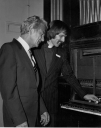
1983 - Moyle Organ Appeal Launch - Prime Minister Bob Hawker with vicar Alan Cadwallader.143 viewsIn 1982, a project commenced to restore the Moyle Organ, a small chamber organ built for a residence, previously used in St Cuthbert’s Brunswick. The organ had been stored by Christ Church Brunswick for some time. St Linus’ expressed a degree of interest in the instrument in 1978. Matters slowly progressed and eventually an appeal was launched under the auspices of the Organ Historical Trust of Australia, with the then local member for Wills, Mr Bob Hawke, and the Archbishop joint patrons of the appeal. The organ was stored in pieces in the hall, the vicarage kitchen cupboards and in local garages until restoration commenced.
The organ appeal was officially launched in November 1993 by the then Prime Minister Hawke, in the company of parishioners, invited guests and journalists, a large number of police and security people and a group of uranium protesters who had followed him from a meeting at the Coburg Town Hall. The afternoon was a great occasion for the parish and the ensuing publicity was of benefit to the appeal.
|
|

2006 - Moyle Organ, built by James Moyle of Prahran circa 1855 and restored by George Fincham & Sons, Melbourne, in 1985142 viewsThis organ was built, probably in the 1850s, by James Moyle, of Prahran. It is thought to be the earliest surviving example of organbuilding in Victoria. The original location of the instrument is unknown and its history is vague until its arrival at St Cuthbert's Anglican Church, Brunswick, about 1930. At some stage the pedal pulldowns were added and the hand-blowing arrangements modified. About 1975, the organ was removed from St Cuthbert's Church and stored at Christ Church, Brunswick. The organ was subsequently given to the National Trust of Australia (Victoria) by the Christ Church parish and it was decided to place the instrument, following restoration, at St Linus' Church on permanent loan.
The restoration of the instrument began in early 1984 following the launching of a restoration appeal by the Prime Minister of Australia, Bob Hawke. The work was carried out by George Fincham & Sons, of Richmond.
This small instrument, of chamber organ dimensions, has a distinctive Gothic case. There are three flats of gilt wooden dummy pipes placed within three cusped arches. The cornice of-the case is boldly crenellated and the music desk, carved in oak, incorporates a lyre motif. The casework is of pine which has been stained and finished to resemble cedar, although the latter material has been used for the keyboard assembly. The hood moulds above the three cusped arches were at some stage removed and have been replaced. The original builder's nameplate survives.
|
|
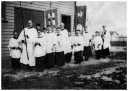
1925 December - Official Opening of the St Linus Hall142 viewsAt a meeting on 1 July 1925, it was resolved that a new hall be built to provide church services for the Anglican people in North Coburg. The hall was built by volunteer labour. The building was begun on 15th August 1925 under Messrs C Ezard, V Black and Henderson, with 30 workmen, and was completed in 14 weekends. Owing to the urgent need for the hall, paid labour was used in the latter stages, and the first service in the hall was conducted by Mr Ball on Sunday, 6 December 1925, with 68 present. Within 7 months of the first Anglican service in Merlynston, the energetic members of this still-rural community were worshipping in a new hall.
|
|

1978 Church Renovations 2141 viewsFor years the unfinished wall of the church had been a source of embarrassment and was a physical reminder of the neglect of the parish over the years. It also worked against the establishment of a solid foundation for ministry. In 1977, following the success of the planned giving programme, the Vestry decided, with the support of Bishop James Grant, that the building should be completed. Mr Vanne Trompf, a creative architect who had successfully carried out some work to Anglican churches, came up with a wonderful solution to replace the temporary wooden eastern wall with a new glass window. The renovation also included a new vestry and church entrance and required the altar to be moved from the eastern end to the western end of the church. The building work was completed and was blessed by Archbishop Robert Dann in a Re-dedication Ceremony on 5th November 1978. A morning prayer service was held at 8:00 AM, followed by a prayer vigil which lasted until the re-dedication ceremony commenced at 4:00 PM.
|
|

1960s St Linus Spring Festival141 viewsDuring the early years of St Linus, many church groups provided support for generations of parishioners - Sunday School, CEBS (Church of England Boys Society), GFS (Girls Friendly Society), Mothers’ Union and YAF (Young Anglican Fellowship) - as well as contributing vital funds to the ongoing support of the parish. Another important contributor to parish finances was the annual parish bazaar. This photo, taken in the 1960s, shows one such bazaar.
|
|

1960s St Linus Spring Festival - Rev. Oliver Hole141 viewsDuring the early years of St Linus, many church groups provided support for generations of parishioners - Sunday School, CEBS (Church of England Boys Society), GFS (Girls Friendly Society), Mothers’ Union and YAF (Young Anglican Fellowship) - as well as contributing vital funds to the ongoing support of the parish. Another important contributor to parish finances was the annual parish bazaar. This photo, taken in the 1960s, shows one such bazaar. Parish priest Rev. Oliver Hole is shown, dressed as usual with biretta and cassock.
"A lasting image is of Oliver Hole riding his bicycle around the streets of Merlynston in the 1950’s, biretta firmly placed on his head, full cassock tucked in around his waist."
|
|

Window - 2022 Jo-Anne Wells and Lois Erickson141 views2020 saw the passing of two very significant people in the St Linus story. First, in August of that year, long serving parishioner Lois Erickson died after a long battle with cancer. Lois's association with St Linus started in the early 1950s as a small child and she spent nearly 70 years as a dedicated member of the church community, taking on roles as Vestry member, Church Council member, Church Warden, Parish Treasurer and Kindergarten President and Treasurer. The Rev. Jo-Anne Wells took on the role of vicar of the Parish of St Matthew's Glenroy with St Linus' Merlynston in November 2011 and served in that capacity until her untimely passing in October 2020. She brought much love, empathy, tolerance and compassion to her role, along with a passion for helping refugees. The members of the parish raised the necessary finances to erect this window, in memory of these two lovingly remembered people.
The window features Jesus with children, to honour Jo-Anne’s work with Playgroup and St. Linus’ kindergarten, and Lois’ tireless work with the Kindergarten, over many, many years.
|
|

2006 - Moyle Organ, built by James Moyle of Prahran circa 1855 and restored by George Fincham & Sons, Melbourne, in 1985141 viewsThis organ was built, probably in the 1850s, by James Moyle, of Prahran. It is thought to be the earliest surviving example of organbuilding in Victoria. The original location of the instrument is unknown and its history is vague until its arrival at St Cuthbert's Anglican Church, Brunswick, about 1930. At some stage the pedal pulldowns were added and the hand-blowing arrangements modified. About 1975, the organ was removed from St Cuthbert's Church and stored at Christ Church, Brunswick. The organ was subsequently given to the National Trust of Australia (Victoria) by the Christ Church parish and it was decided to place the instrument, following restoration, at St Linus' Church on permanent loan.
The restoration of the instrument began in early 1984 following the launching of a restoration appeal by the Prime Minister of Australia, Bob Hawke. The work was carried out by George Fincham & Sons, of Richmond.
This small instrument, of chamber organ dimensions, has a distinctive Gothic case. There are three flats of gilt wooden dummy pipes placed within three cusped arches. The cornice of-the case is boldly crenellated and the music desk, carved in oak, incorporates a lyre motif. The casework is of pine which has been stained and finished to resemble cedar, although the latter material has been used for the keyboard assembly. The hood moulds above the three cusped arches were at some stage removed and have been replaced. The original builder's nameplate survives.
|
|
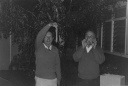
1965 BBQ at Creswell family home in Shorts Road - Charlie Newman and Ray Evenden141 viewsParish stalwarts Charlie Newman and Ray Evenden are shown in this 1965 photo of a parish BBQ at the Creswell family home in Shorts Road.
Photo supplied by Ian Pollard.
|
|

1932-02-20 - Laying of Foundation Stone140 viewsIn January 1932, when the church was under construction, Archbishop Head came for the placing of the memorial stone at the North East corner of the church porch (in Delta Avenue) on Saturday 20 February at 3 PM. The inscription reads:
"To the greater glory of God. This stone was laid on 20th February Anno Domii 1932 by the Most Rev. Frederick Waldergrave Head, D.D.' Archbishop of Melbourne. Rev. W. Clarke Hudson, M.A., Vicar. C.R. Heath A.R.A.I.A., architect".
The mayor (Cr J J Anderson), and other councillors were present, along with a large group of clergy.
|
|

1987 St Linus Op Shop Opening140 viewsRev. Alan Cadwallader's time as Parish Priest saw many initiatives in the parish. The hall was renovated and finally re-blocked, an Op Shop was opened, the Moyle Organ was installed, parish camps were commenced and the fete became a highly organised affair. The Parish Op Shop was opened in 1987 and ran for many years as a valuable resource for the local community.
|
|
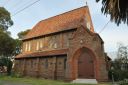
2016 Church Delta Avenue view140 viewsThis 2016 photo of St Linus shows the northern side, from Delta Avenue. This was originally the front entrance to the church, and the memorial stone (laid in 1932) is just to the left of the front porch.
|
|

1954 Easter - Rev Oliver Hole139 viewsThe Rev. Oliver Hole was appointed to St Linus’ in 1951. Rev. Hole had previously enjoyed a successful ministry, having been precentor at the Cathedral and Vicar of St Peter’s Box Hill. However, in what was ultimately an unsuccessful arrangement, the Rev’d Hole was sent to St Linus’ with the promise of only a part stipend, but with an additional income stemming from the Chaplaincy to Fawkner Cemetery (which in practice meant taking funerals). This proved unviable and his long tenure in the parish was marked by ongoing financial difficulties and declining income. Fr. Hole eventually retired in 1971, having led the parish for some 20 years.
|
|

1930 Merlynston Junior Football Club139 viewsBy the late 1920s, Merlynston had football and cricket teams. In fact, in 1931 St Linus Church formed its own cricket team which subsequently won the 1933 Coburg Districts Cricket League grand final. Over 300 people attended the club's annual presentation awards in the St Linus Hall to celebrate the win.
|
|
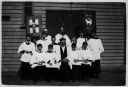
1925 December - Official Opening of the St Linus Hall139 viewsAt a meeting on 1 July 1925, it was resolved that a new hall be built to provide church services for the Anglican people in North Coburg. The hall was built by volunteer labour. The building was begun on 15th August 1925 under Messrs C Ezard, V Black and Henderson, with 30 workmen, and was completed in 14 weekends. Owing to the urgent need for the hall, paid labour was used in the latter stages, and the first service in the hall was conducted by Mr Ball on Sunday, 6 December 1925, with 68 present. Within 7 months of the first Anglican service in Merlynston, the energetic members of this still-rural community were worshipping in a new hall.
|
|
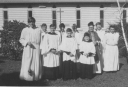
1968 A Festival Day at St Linus139 views1968 A Festival Day at St Linus
Front row:Peter Godden with thurifier, Ron Cruickshank, unknown, Martin Evans with Fr Oliver Hole
Back row: David van Cuylenberg, unknown, Robert King, Ian Pollard and Charlie Newman
Photo supplied by Ian Pollard.
|
|
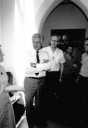
1990 March - Local member Bob Hawke with vicar John Simpson139 viewsThe 1990 Federal Election was held in March of that year and St Linus was one of the Wills Electorate polling booth. Prime Minister Bob Hawke was our local member and dropped in and is pictured here in the church with vicar John Simpson.
|
|

A St Linus Gathering of Parishioners138 viewsDate and occasion unknown.
|
|
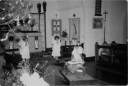
1950s St Linus Nativity Play138 viewsThis 1950s photo shows a Nativity Play taking place in the St Linus Church
|
|
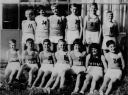
1968 St Linus U14 Basketball team138 viewsAnother photo from Ian Pollard showing the 1968 St Linus U14 Basketball team. Players are
11 Neil Cooper, 34 unknown, 8 Alan Bell, 7 Alan Whiteside, 4 Neil Pollard, 12 Stuart Cooper, 30 John Percival, 9 Geoffrey Maunder, 21 Trevor Sibbald, 6 John Lewis, 20 Michael Crivelli, 33 Greg Lambert, 30 Garry Percival and 24 John Young.
Photo supplied by Ian Pollard.
|
|
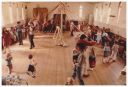
1980s mid - Spring Festival Colour137 viewsRev Alan Cadwallader who had been at Holy Trinity Kensington, took over the Parish in late 1982. Fr Alan was married and the parish, after some time, once again had a family at St Linus’ House. Alan and Robin’s family of two children increased to four during their five years at St Linus’. This was a time of much creativity and spiritual growth. Outreach to the community increased as Alan’s spirit of inclusiveness found an expression in events such as the annual parish camp, attended by parishioners of all age groups and others, including the from kindergarten. The annual Spring Festival, Easter and St Linus Day celebrations of Eucharist and feasting were very popular and the introduction of a Sunday night Taize service flowed from the raised interest in liturgical issues and attracted numbers of people from outside the parish. When Fr Alan left the parish in 1988, he left a legacy seen not only in the physical fabric of the church plant, but also in the deep spiritual growth of many parishioners.
|
|

2016 Church Window137 viewsThis 2016 photo shows the front window, in side profile. This window was erected as part of the 1978 refurbishment and replaced what was a temporary wooden wall, erected in 1932 when the church building had to be stopped as available funds were exhausted. It was a temporary wall that lasted 46 years!
|
|
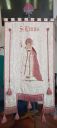
St Linus Banner137 viewsThe Rev’d W Clarke Hudson left a memorandum concerning his choice of Saint Linus as patron saint, in which he wrote:
“St Linus was chosen as the patron saint of this church because he was a Briton, almost the first Briton mentioned in history, and certainly the first British saint. He was the son of King Caradoc, who, tradition relates, was converted to Christianity by the mission to Glastonbury about the middle of the first century. King Caradoc was conquered and carried captive with his family to Rome by the Emperor Claudius, but his noble demeanour so affected Claudius that the latter gave Caradoc his liberty, and that of his whole family, who thus became Roman citizens. Linus was the first Bishop of Rome, sometime between 56 and 80 AD. St Paul, in his second Epistle to Timothy , Chapter 4, verse 21, numbers Linus, Claudia and Pudens (her husband) among the early Christians. The Apostolical Constitutions tell us that Linus and Claudius were brother and sister. We learn from tradition that Linus was beheaded by order of Saturninus for refusing to give up the faith”
|
|
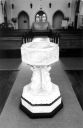
The Baptismal Font137 viewsIn November 1932, the church was the recipient of a magnificent gift of the marble font, made secretly by Mr H J Thornton during 2 years' work. It was dedicated on Wed 23 November at 8 PM by the Rural Dean, Canon Rowed. The first baptism in the new font followed immediately, that of Mr Thornton's granddaughter, Patricia Joan Murray. The font has been much praised over the years and has pride of place in the large window of the completed church building, inviting passers-by to enter God’s kingdom through baptism.
|
|

Window - 1949 Amelia Stubbings137 viewsAmelia Stubbings, of O'Hea St in Coburg, was Ray Evenden's aunt and, although a longstanding and faithful member of Holy Trinity Coburg, was a loyal supporter of the newly established St Linus' Church. After her death, the Evenden family had this window installed at St Linus. It reads:
In loving memory of Amelia Stubbings
Obiit 15th July 1949, aged 81 years.
A faithful member of the parish of Holy Trinity Coburg
and a friend of this church.
|
|

Window - 1952 Errol Robert Warnock137 viewsErrol Robert Warnock died 21 March 1952, aged 13 years, as the result of an accident. The dearly loved son of Robert and Linda Warnock of 87 Queens Pde Fawkner, and loved brother of Ron, aged 14 years.
|
|

1929 Merlynstnon Public School opening137 viewsMerlynston State School 4328 opened in a new three-storey red-brick building on Bakers Road in 1928, set in grounds that won the A.N.A. garden prize. A large reserve adjoined the school on two sides. The opening was a grand affair, as this newspaper spread attests.
It closed at the end of 1993 and was promptly sold for $1.15m. In 1995 it became the secondary campus of King Khalid Islamic College (now known as Australian International Academy). Fortunately, the Academy retained the imposing red-brick building, which did not have heritage protection at the time.
|
|
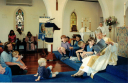
2004 Rev. Willy Maddocks reads a story to the children137 viewsRev. Willy Maddocks was the vicar of St Matthew's Glenroy from 1995 to 2001 and then became the vicar of the newly combined parish of St Matthew's Glenroy with St Linus' Merlynston. Willy had a very active vision of extending the service to include the younger members of the parish. Here she reads a story to the younger congregation members at St Linus during one of her Sunday services.
|
|

1978 Church Renovations 1136 viewsFor years the unfinished wall of the church had been a source of embarrassment and was a physical reminder of the neglect of the parish over the years. It also worked against the establishment of a solid foundation for ministry. In 1977, following the success of the planned giving programme, the Vestry decided, with the support of Bishop James Grant, that the building should be completed. Mr Vanne Trompf, a creative architect who had successfully carried out some work to Anglican churches, came up with a wonderful solution to replace the temporary wooden eastern wall with a new glass window. The renovation also included a new vestry and church entrance and required the altar to be moved from the eastern end to the western end of the church. The building work was completed and was blessed by Archbishop Robert Dann in a Re-dedication Ceremony on 5th November 1978. A morning prayer service was held at 8:00 AM, followed by a prayer vigil which lasted until the re-dedication ceremony commenced at 4:00 PM.
|
|
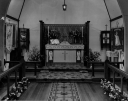
1950 St Linus Altar136 viewsThis photo, produced for the St Linus 25 Year anniversary, showcases the alter which was richly decorated with tapestries and banners.
|
|
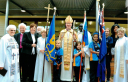
2016 Blessing of new St Linus Hall136 viewsThe old St Linus Hall had been built in the late 1920s and had well and truly reached it use-by-date by the early 2000s. Under the guidance of then vicar Rev. Jo-Anne Wells, funds were sourced and a new hall was built. The photo shows the official opening on Sunday 25th September 2016.
|
|

1932-02-20 - Laying of Foundation Stone - the attending clerics135 viewsIn January 1932, when the church was under construction, Archbishop Head came for the placing of the memorial stone at the North East corner of the church porch (in Delta Avenue) on Saturday 20 February at 3 PM. The inscription reads:
"To the greater glory of God. This stone was laid on 20th February Anno Domii 1932 by the Most Rev. Frederick Waldergrave Head, D.D.' Archbishop of Melbourne. Rev. W. Clarke Hudson, M.A., Vicar. C.R. Heath A.R.A.I.A., architect".
The mayor (Cr J J Anderson), and other councillors were present, along with a large group of clergy which included Canon Rowed (who read the lesson), the Rev C H Murray (in 1950, the Bishop of Riverena), who carried the Archbishop's staff,; the Revs H S Hollow, E I Gason, J W Briggs, W A Shaw, A R Sinclair, J A Peck, J J Tempany , L L Nash, A E Sedsman and J V Gason.
|
|

1935 St Linus Choir Easter Times - 1135 viewsA strong musical and ceremonial tradition was evident at St Linus right from the start, with a robed choir gracing the services until 1977.
This holy card shows the Choir times for Easter 1935. It was indeed a full program
Palm Sunday - Matins 9:30AM, Catechism 3PM, Ceremony and Procession 7PM
Wednesday in Holy Week - Eucharist 6:30PM, Evensong 7:30PM
Good Friday - Matins 11AM, Way of the Cross 2:30PM
Holy Saturday - Preparation for HC 7:15PM
Easter Day - Sung Eucharist 9:30AM, Festal Catechism 3PM, Festal Evensong 7PM
|
|

Window - 1996 Frederick Maurice Van Cuylenburg135 viewsThe van Cuylenburg and de Moore families were steadfast supporters of St Linus Parish from the 1950s onwards. Eileen de Moore was the church organist for many years, while her brother Maurice van Cuylenburg lent his legal expertise to the parish on many occasions.
|
|
|
|


 Home
Home Login
Login Album list
 Last uploads
 Last comments
 Top rated
 My Favorites
 Search